Olympic Weightlifting for Beginners: Achieving Explosive Power
The Pinnacle of Barbell Mastery
If powerlifting is about raw, grinding strength, Olympic weightlifting is about speed, precision, and explosive power. The two contested lifts—the Snatch and the Clean & Jerk—are arguably the most athletic movements you can perform with a barbell. They require an unparalleled combination of mobility, coordination, absolute strength, and neurological timing.
For decades, Olympic weightlifting was a niche sport confined to specialized eastern European gyms. However, the functional fitness explosion has brought these dynamic lifts to the mainstream. In 2026, mastering these lifts is seen as the ultimate badge of honor in the iron game. But learning them is a profound test of patience.
This guide provides the foundational roadmap for beginners looking to conquer gravity and move heavy weight fast.
1. The Pre-Requisites: Mobility Over Muscle
Before you ever attempt to snatch a barbell over your head, you must pass the mobility test. Olympic lifts require extreme ranges of motion that the average desk-worker severely lacks.
Thoracic Extension and Shoulder Flexion
To hold a heavy barbell overhead in a deep squat (the receiving position of the Snatch), your upper back (thoracic spine) must be able to extend, and your shoulders must be able to flex past 180 degrees without your lower back hyperextending.
- The Benchmark: Can you perform a perfect overhead squat with a PVC pipe? If your heels come off the ground, your chest collapses forward, or your elbows bend, you must prioritize mobility before loading the lift.
Ankle Dorsiflexion and Hip Rotation
The "catch" position of the clean and the snatch requires you to sit in a rock-bottom, ass-to-grass squat with an upright torso. This is physically impossible without excellent ankle flexibility (dorsiflexion) and hip external rotation.
- The Benchmark: Spend 5-10 minutes every day in the bottom of a deep "Goblet Squat" stretch to open the hips and stretch the Achilles tendon.
2. Deconstructing the Snatch
The Snatch is moving the barbell from the floor to overhead in one continuous, explosive motion. It is the most technical movement in weightlifting.
Step 1: The Setup and First Pull
- Use a wide grip (the bar should rest in the crease of your hips when standing tall).
- Keep your chest up and shoulders slightly in front of the bar.
- The Pull: Push the floor away with your legs. The angle of your back should not change until the bar passes your knees. This is not a deadlift; the goal is positioning, not speed, off the floor.
Step 2: The Transition and Second Pull (The Explosion)
- Once the bar passes the knees, aggressively open your torso and drive your hips into the bar (into the "power position").
- Violently extend your hips, knees, and ankles (triple extension) while simultaneously shrugging your shoulders.
Step 3: The Third Pull and The Catch
- This is where most beginners fail. You do not simply pull the bar up; you pull yourself under the bar.
- As the bar travels upward from the hip drive, actively pull your body down into a deep squat, locking your arms out aggressively overhead exactly as you hit the bottom position.
- Stand up to complete the lift.
3. Deconstructing the Clean & Jerk
The Clean & Jerk consists of two distinct movements: bringing the bar from the floor to the shoulders (the Clean), and driving it from the shoulders to overhead (the Jerk).
The Clean
- The first and second pulls are nearly identical to the snatch, but with a narrower, shoulder-width grip.
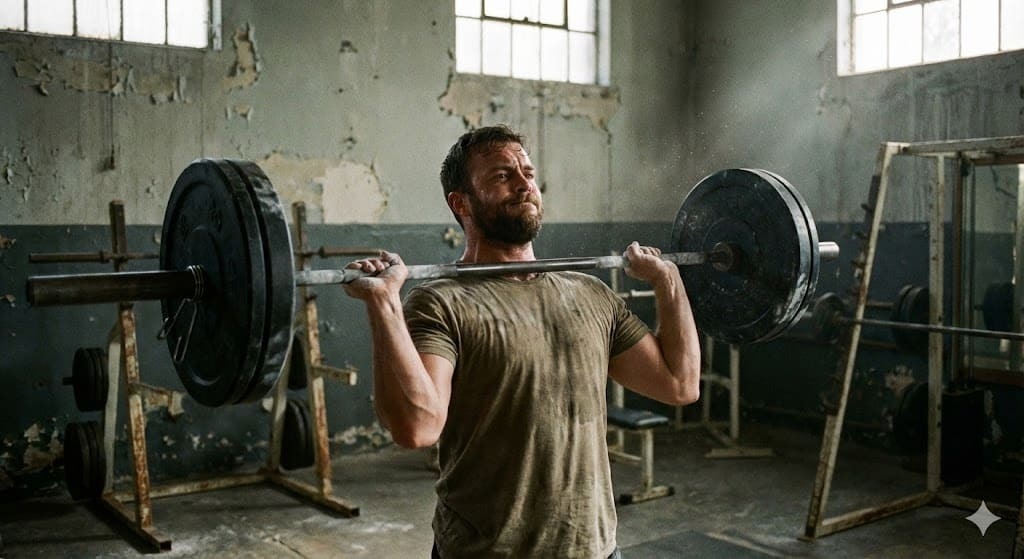
- The Turnover: After you explosively extend your hips and shrug, you must quickly rotate your elbows around and under the bar, catching it on your anterior deltoids (front of the shoulders) while dropping into a front squat.
- The Front Rack: Your elbows must point straight forward, not down at the floor. This requires significant wrist and lat mobility.
The Jerk
- Stand tall with the weight resting solidly on the meat of your shoulders.
- The Dip and Drive: Dip straight down slightly (bending only the knees, keeping the torso perfectly vertical), and explosively drive the bar off your shoulders.
- The Split Catch: As the bar flies upward, violently split your legs—one forward, one backward—and lock your arms out.
- Recover by stepping the front foot back first, then the back foot forward.
4. The Beginner's Training Template
When learning Olympic lifts, volume and fatigue are your enemies. You cannot learn high-level motor skills when you are exhausted.
Rule 1: High Frequency, Low Reps
- Train the lifts 3 to 4 times a week.
- Keep the reps per set between 1 and 3. Doing sets of 10 Snatches is cardio, not technique practice, and will only hardwire terrible movement patterns as fatigue sets in.
Rule 2: Top-Down Learning (Hang Variations)
Do not start from the floor. Learning the "explosive" portion is the priority.
- Spend your first 4 weeks mastering the Hang Power Snatch and Hang Power Clean (starting with the bar just above the knee). This simplifies the movement and teaches you how to generate power from the hips without worrying about navigating around the knees from the floor.
A Typical Beginner Session
- Dynamic Mobility: 15 minutes of ankles, hips, and thoracic spine.
- Primer: PVC Pipe Overhead Squats (3x5).
- Skill Work: Hang Power Snatches (5 sets of 2 reps @ light weight).
- Strength Work: Heavy Front Squats (4 sets of 3 reps).
- Accessory: Heavy Core training (Planks, hanging leg raises).
5. The Role of the Coach and Video Analysis
You cannot self-correct what you cannot see. Because these movements happen in fractions of a second, "feel" is often deceiving.
- Record Every Working Set: Use your phone to film your lifts from a 45-degree front angle.
- Look for early arm bending (pulling with the biceps instead of the hips), shoulders finishing behind the bar too early, or a soft lockout in the catch.
- Use advanced logging tools like RepLog to attach your technique videos directly to your workout logs, allowing you to track your visual progress alongside your weight progression over time.
Summary: The Pursuit of Perfection
Olympic weightlifting is a lifelong pursuit. It is incredibly frustrating in the beginning, as you will likely be able to deadlift 300 lbs but might struggle to snatch 95 lbs with good form. Check your ego at the door. Embrace the empty barbell. Prioritize your mobility, focus on speed under the bar, and slowly let the intricate puzzle pieces of the Snatch and Clean & Jerk come together.
Ready to track smarter?
RepLog helps you implement everything you just learned with intelligent workout tracking.
Download RepLog Free