The Biomechanics of the Barbell Squat: Analyzing Force and Form
Decoding the King of Lifts
The barbell back squat is universally hailed as the king of all exercises. It demands full-body coordination, mobility, and immense strength. However, the squat is also one of the most mechanically complex movements performed in the gym. Understanding the biomechanics behind the squat is essential for both maximizing load and minimizing injury risk.
The Physics of the Squat
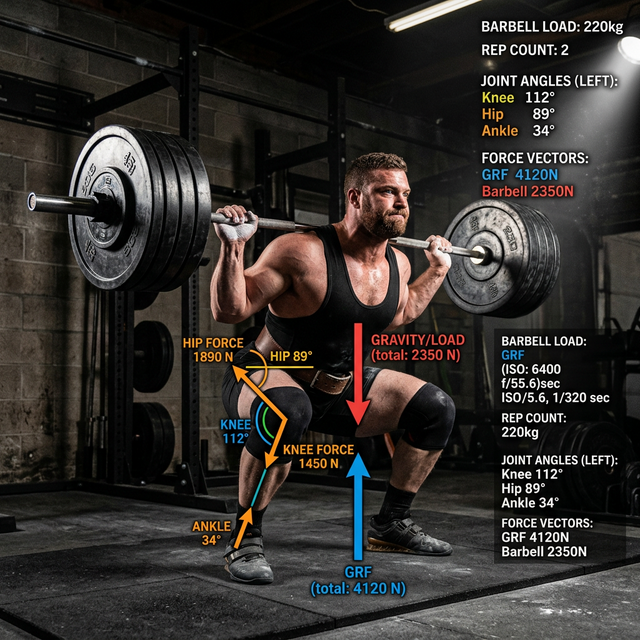
At its core, the squat is a battle against gravity, governed by the principles of torque and leverage. When the barbell is on your back, gravity pulls it straight down (the line of force). The distance between any joint (hips, knees) and this line of force creates a moment arm.
Torque and Moment Arms
- Hip Dominant vs. Knee Dominant: A squatter who leans forward heavily increases the moment arm at the hips, requiring the glutes and erectors to produce massive torque. Conversely, an upright squatter shifts the moment arm to the knees, placing the mechanical demand on the quadriceps.
- The Goal: Optimal efficiency involves balancing these moment arms to distribute the load across multiple muscle groups, preventing any single joint from becoming a limiting factor.
Joint Path Kinematics
The bar path in a perfect squat should be a perfectly vertical straight line over the mid-foot. Any deviation from this line requires additional energy to correct and places undesirable shear forces on the joints.
The Role of Ankle Dorsiflexion
Limited ankle dorsiflexion is the most common culprit for poor squat mechanics. If the knees cannot travel forward, the lifter is forced to compensate by excessively hinging at the hips to achieve depth, turning the squat into a "good morning."
- Improving Mobility: Dedicated calf stretching and utilizing squat shoes with an elevated heel can artificially improve dorsiflexion angles, allowing for a more upright torso and better quad recruitment.
Force Vectors and Ground Reaction Force (GRF)
To stand up from the bottom of a squat, you must exert force into the ground. Newton’s Third Law dictates that the ground exerts an equal and opposite force back—this is the Ground Reaction Force (GRF).
- Vector Alignment: The direction of your GRF is critical. If you push through your toes, the force vector drives you forward, throwing you off balance. By actively gripping the floor with your entire foot (the "tripod foot" cue), you ensure the GRF vector points straight up, directly opposing the load on your back.
Intra-Abdominal Pressure (IAP)
The spine is inherently unstable under heavy compressive loads. Intra-Abdominal Pressure (IAP) is the mechanism by which the core muscles, diaphragm, and pelvic floor create a rigid cylinder, stabilizing the lumbar spine.
- The Valsalva Maneuver: Taking a deep diaphragmatic breath and holding it (the Valsalva maneuver) maximizes IAP. This is not just a "safety" technique; it is a fundamental requirement for the efficient transfer of force from the legs, through the torso, to the barbell.
Summary
The difference between an average squatter and an elite squatter is an uncompromising adherence to mechanical efficiency. By understanding how to manipulate moment arms, optimize your bar path, and maximize force production through strict technique, you can unlock unparalleled progress in the squat rack.
Ready to track smarter?
RepLog helps you implement everything you just learned with intelligent workout tracking.
Download RepLog Free