Bio-Individual Programming: The Death of the Cookie-Cutter Workout Plan
One Size Fits None
In the early days of fitness, we relied on "templates." The 5x5, the PPL, the German Volume Training. While these programs were based on sound principles, they all suffered from the same flaw: they assumed every human body recovers and adapts at the same rate.
In 2026, the "cookie-cutter" plan is dead. We have entered the era of Bio-Individual Programming. This isn't just a custom plan; it's a plan that customizes itself every single day based on your physiological feedback.
1. The Variance of Human Biology
Why does one lifter flourish on 20 sets of chest per week while another stalls on 10? The answer lies in a complex intersection of variables:
- Muscle Fiber Type Distribution: A "fast-twitch dominant" athlete might need lower volume and higher intensity.
- Connective Tissue Resilience: Some individuals have tendons that can handle daily heavy loading; others require longer deload cycles.
- Metabolic Efficiency: Your ability to clear lactate and resynthesize ATP dictates your optimal rest periods.
Traditional programming ignores these nuances. Bio-Individual programming makes them the priority.
2. The Data Inputs for Customization
How does an automated system like RepLog build a bio-individual profile? It looks at three primary data streams:
A. Performance Metrics
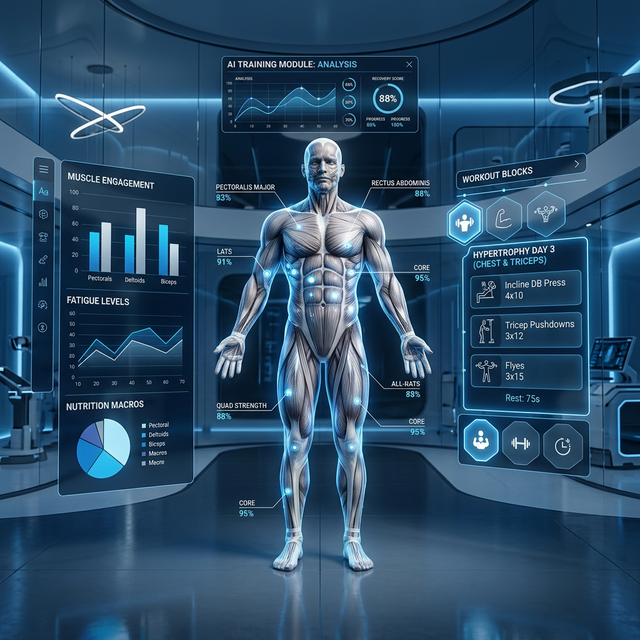
We don't just track the weight; we track the Velocity and the RPE Trend. If your strength in the 8-rep range is increasing but your 1RM is stagnant, the AI identifies that you are a "Volume Responder" and adjusts your programmed intensity accordingly.
B. Biometric Integration
By syncing with wearables, the system monitors your Heart Rate Variability (HRV) and Sleep Architecture. If your HRV is trending down over 3 days, the system knows your CNS is overreached before you feel the symptoms in the gym.
C. Subjective Feedback
RepLog prompts you for simple but critical inputs:
- "How was your joint health?"
- "How was your motivation?"
- "Where is your soreness (DOMS) on a scale of 1-10?"
3. The Feedback Loop: Automated Adjustments
The magic happens in the adjustment phase. In 2026, you don't wait for your 12-week block to end to make changes.
- Dynamic Volume Scaling: If you report a 7/10 soreness in your quads for three consecutive sessions, the system automatically reduces your set volume for the following week to allow for full recovery.
- Auto-Regulated Intensity: On days where your sleep was poor but your HRV is stable, the system might prescribe "Cluster Sets" to maintain total tonnage without the high neural cost of straight sets to failure.
- Exercise Selection Mapping: The AI analyzes which exercises correlate with your fastest strength gains. If your Squat increases every time you do Romanian Deadlifts but stalls when you do Leg Press, the system will prioritize RDLs in your next block.
4. The Benefits of Individualization
- Reduced Injury Risk: By catching overreaching early through biometric and joint-pain tracking.
- Consistent Progress: No more "wasted" weeks on a program that isn't working for your specific biology.
- Mental Freedom: You don't have to second-guess the plan. The data has already done the thinking for you.
Summary: Your Body, Your Data, Your Plan
Bio-individual programming represents the ultimate marriage of sports science and technology. It respects the fact that you are an individual with unique recovery landmarks. In 2026, the best coach isn't the one who shouts the loudest; it's the one that listens to your data the most.
Stop following the crowd. Start following your biology.
Ready to track smarter?
RepLog helps you implement everything you just learned with intelligent workout tracking.
Download RepLog Free